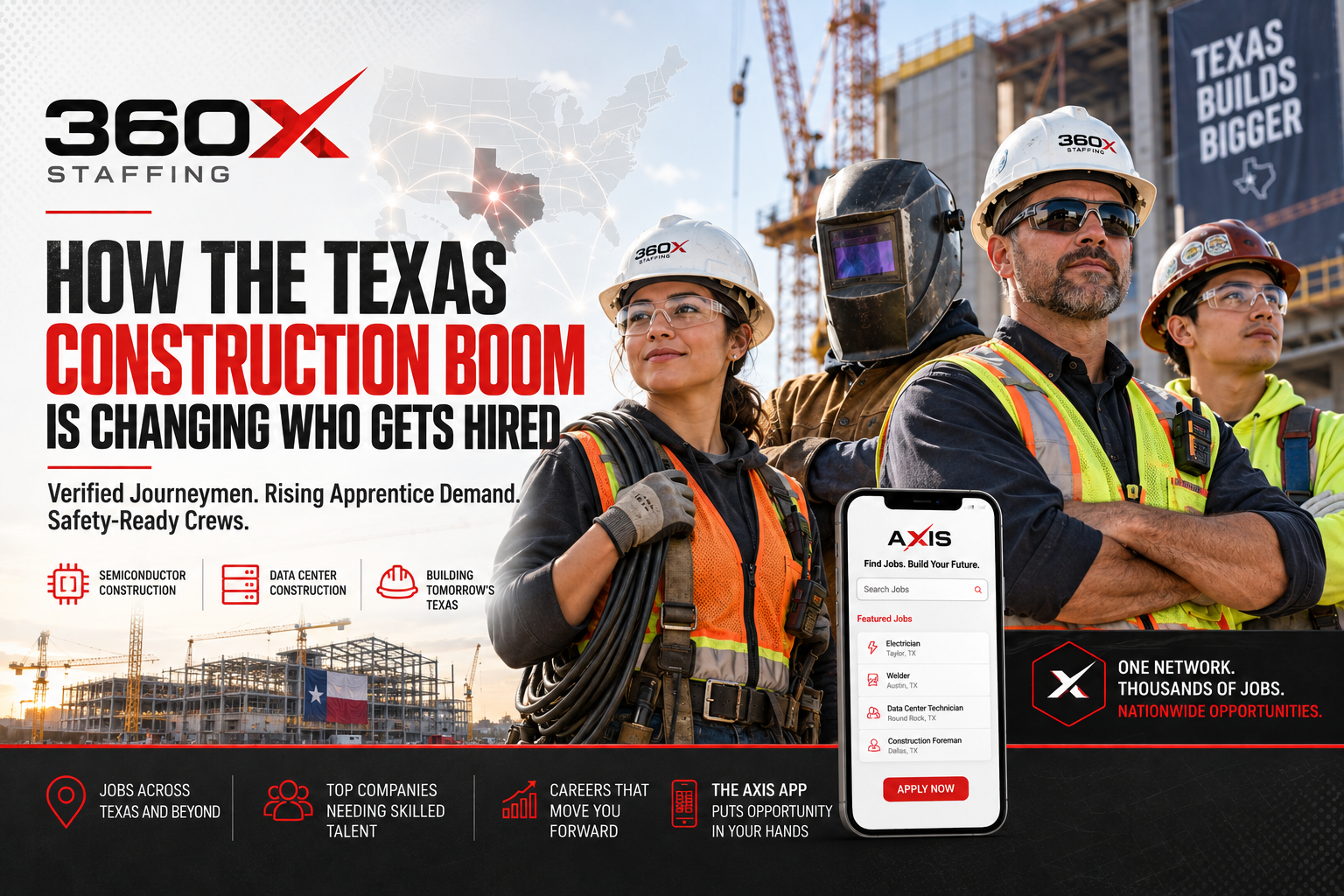
How the Texas Construction Boom Is Changing Who Gets Hired
Key Takeaways
- Texas semiconductor and data center construction is reshaping who gets hired.
- Regulated job sites demand verified journeymen, not unscreened labor.
- Apprentice demand is rising as journeyman shortages grow.
- Safety preloading and credentialing prevent costly onboarding delays.
- A body shop model fails on code-regulated Texas projects.
The Bar for a Qualified Worker Has Risen
The scale of construction in Texas has changed what employers look for in a worker. Semiconductor fabrication plants and hyperscale data centers do not run on general labor. They run on verified, credentialed trades who can perform to code from the first shift.
That shift has raised the bar for every contractor competing for skilled hands. The question is no longer only whether you can find a welder or electrician. It is whether that worker is qualified, safety-ready, and documented before they reach the gate.
Contractors can build a qualified workforce through a staffing partner designed for exactly these conditions. 360X Staffing screens, verifies credentials, and deploys skilled trades built for regulated Texas job sites.
This article examines how the Texas boom is changing who gets hired, why journeyman and apprentice demand is rising together, and what separates a true staffing partner from a body shop.
Job availability and deployment timelines vary by trade, market, and project scope. 360X Staffing is an equal opportunity employer, and every placement meets applicable licensing and certification requirements.
The Projects Driving the Shift
Two sectors are rewriting Texas construction hiring: semiconductors and data centers.
Semiconductor fabrication in the Austin, Georgetown, and Taylor corridor requires cleanroom-grade electrical, mechanical, and process piping work. Tolerances are tight, and inspections are constant. Data center construction near Abilene and across the Dallas-Fort Worth region moves on compressed schedules that demand large, credentialed crews on short notice.
Both sectors share a defining trait. They cannot absorb unqualified labor without risking rework, failed inspections, and schedule loss. That reality has pushed Texas construction contractors toward partners who can guarantee credentials, not just fill seats.
Journeyman vs. Apprentice: Demand Is Rising on Both Sides
The talent gap is not limited to senior trades. It runs the full length of the pipeline.
Journeyman electricians, combination welders, and pipefitters remain the most requested roles, because complex systems require workers who can execute without supervision. At the same time, the sheer volume of work in Texas has created strong demand for apprentices who can build hours under those journeymen. Registered apprenticeship programs feed the pipeline that keeps large projects staffed across multi-year timelines.
| Role level | What projects need them for | Why demand is rising |
| Journeyman | Independent, code-compliant execution | Semiconductor and data center complexity |
| Apprentice | Supported production work and pipeline growth | Multi-year project volume and ratio requirements |
| Foreman | Crew leadership, scheduling, safety oversight | Larger concurrent crews on tight schedules |
Contractors who plan for both levels protect their schedules. A partner that supplies journeymen and supports apprenticeship ratios keeps a project staffed today and sustained tomorrow.
Safety Preloading: The New Baseline
On regulated Texas job sites, safety is not an orientation step. It is a precondition for entry.
Semiconductor and data center owners require workers to arrive with current OSHA certifications, site-specific safety training, and verified trade credentials. A worker who shows up without them does not start, which means a lost day for the contractor. Safety preloading solves this by completing certification checks and documentation before deployment, so every worker clears the gate on day one.
This front-loaded approach is where a technology-driven staffing partner proves its value, because verified credentials move a crew onto the site instead of into a holding pattern.
Why a Body Shop Fails on Regulated Sites
The traditional temp agency model was built for volume, not verification. On modern Texas projects, that model breaks down.
A body shop sends available workers and leaves screening to the contractor. On a semiconductor or data center site, that approach invites failed credential checks, safety violations, and rework that no schedule can absorb. The cost of an unqualified worker is not the wage. It is the inspection failure, the rework, and the delay.
360X Staffing operates on the opposite principle. As a Staffing Experience Management (SXM) company, it treats every placement as a credentialed, code-compliant deployment tracked through the AXIS platform. Contractors receive workers who are screened, certified, and documented before they arrive. Employers managing full builds can see how this model sustains momentum in the companion guide, How 360X Staffing Helps Contractors Keep Projects Moving.
Expert Insight: The Real Cost Lives in the Rework, Not the Wage
Contractors comparing staffing suppliers often focus on the hourly rate. On regulated Texas job sites, that is the wrong number to watch. A single unqualified worker who fails a credential check or triggers a safety stop can cost more in one afternoon than the rate difference across an entire crew. Semiconductor and data center owners hold contractors to strict compliance standards, and rework flows downhill to the trade partner. Suppliers that win this work eliminate that risk before deployment, not those that quote the lowest number.
Frequently Asked Questions
How is the Texas construction boom changing hiring? The boom in semiconductor and data center construction has raised the bar for credentials. Contractors now prioritize verified, safety-ready journeymen and apprentices over general labor, because regulated sites cannot absorb unqualified workers.
Are apprentices in demand in Texas construction? Yes. Apprentice demand is rising alongside journeyman shortages, driven by multi-year project volume and registered apprenticeship ratio requirements on large builds.
What is safety preloading? Safety preloading completes OSHA certifications, safety training, and credential verification before a worker deploys. It ensures every worker clears jobsite entry on day one, preventing lost time.
Why does a temp agency model fail on regulated sites? A body shop supplies workers without full screening, which invites failed credential checks, safety violations, and rework. Regulated Texas job sites require verified, code-compliant trades from the first shift.
What should contractors look for in a construction staffing partner? Contractors should look for verified credentials, safety preloading, apprenticeship support, and real-time documentation. 360X Staffing delivers these through the AXIS platform across Texas projects.
Hiring for the Boom
The Texas construction boom has changed who gets hired and what contractors need from a staffing partner. Verified journeymen, a growing apprentice pipeline, and safety-ready crews are now the baseline for semiconductor and data center work. Contractors who partner with a firm built for regulated sites protect their schedules, their inspections, and their margins.
Build With 360X Staffing
360X Staffing has connected contractors with credentialed artisans for more than sixty years. Through the AXIS platform and safety-preloaded deployment, the firm delivers skilled trades built for the demands of regulated Texas projects.
To build a crew ready for the boom, connect with 360X Staffing or call 602-903-7999 to request the trades your project needs.
Deployment timelines vary by trade, market, and project scope. 360X Staffing is an equal opportunity employer, and every placement meets applicable licensing and certification requirements.

